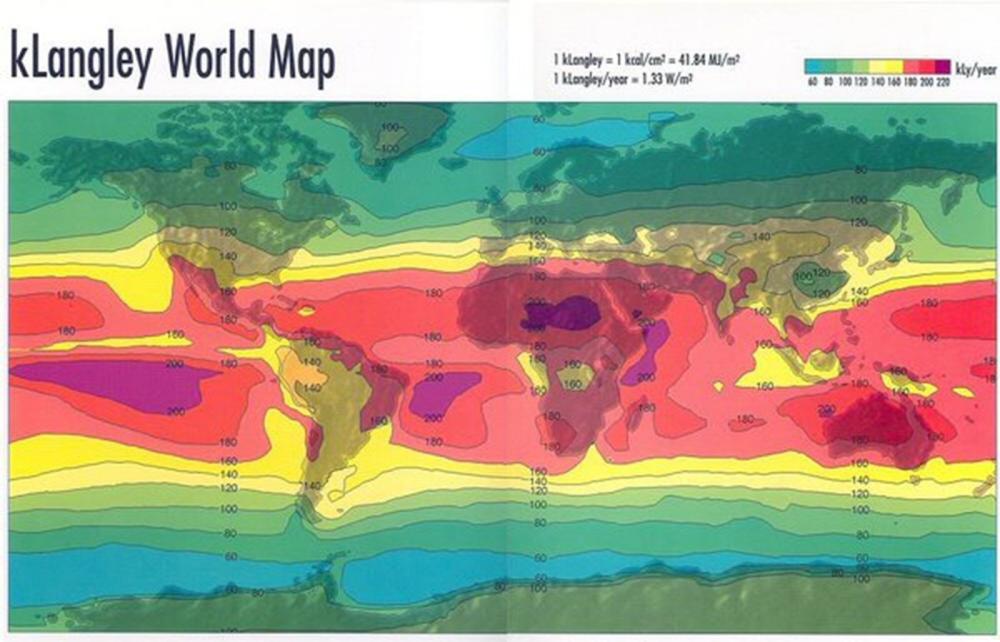
What is kilo-Langley (kLy)? kLy stands for kilo-Langley, a unit used to measure the annual amount of solar energy (insolation) incident on a surface, particularly in the context of UV radiation and material degradation. One Langley (Ly) is equal to 1 calorie per square centimeter (approximately 41,840 J/m²). One kLy is therefore 1,000 Langleys, or the total solar energy a material receives per year in a given area. This unit is particularly relevant in materials science, such as for plastics, nets, and films used outdoors (e.g., in agriculture or horticulture). It measures the UV stress that degrades materials by breaking chemical bonds, leading to discoloration, cracking, and loss of strength. Products are often tested for their UV stability in kLy, with a higher kLy value indicating a material that is more resistant to degradation. For example, a product with 120 kLy stability will retain at least 50-70% of its original strength after exposure to that amount of radiation.
| Region | Average annual kLy |
|---|---|
| Polar regions | 60 |
| Central Western Europe | 100 |
| Warm regions (e.g., Northern Spain) | 100-120 |
| Southern Spain | 140 |
| African desert | 200 |
These values vary due to factors such as latitude, cloud cover, and elevation.
Explanation of how mechanical friction and stress affect service life
Mechanical friction (friction): Friction occurs during contact and movement between surfaces, such as during abrasion, wind load, or use (e.g., nets flapping or film rubbing against structures). This leads to abrasion (wear), where the surface layer erodes.
Influence on service life: Friction removes protective layers (such as UV stabilizers), causing deeper layers to be exposed to UV radiation more quickly. This accelerates degradation, especially at high kLy loads (e.g., in sunny regions). The result: faster cracking, reduced tensile strength, and a shorter service life. For example, an agricultural net in an area with 140 kLy can see its service life reduced by 20-50% due to friction, depending on the intensity.
Certain acids also significantly affect the degradation and service life of materials such as plastics, nets, and films, especially in combination with UV radiation (measured in kLy). Acids can occur in forms such as acid rain (containing sulfuric, nitric, and acetic acids), industrial pollution, or environmental exposure. They accelerate degradation through chemical reactions like hydrolysis and etching, which works synergistically with UV degradation.